
V-die selection
Narrower V increases tonnage quickly; wider V reduces force but increases radius and minimum flange.
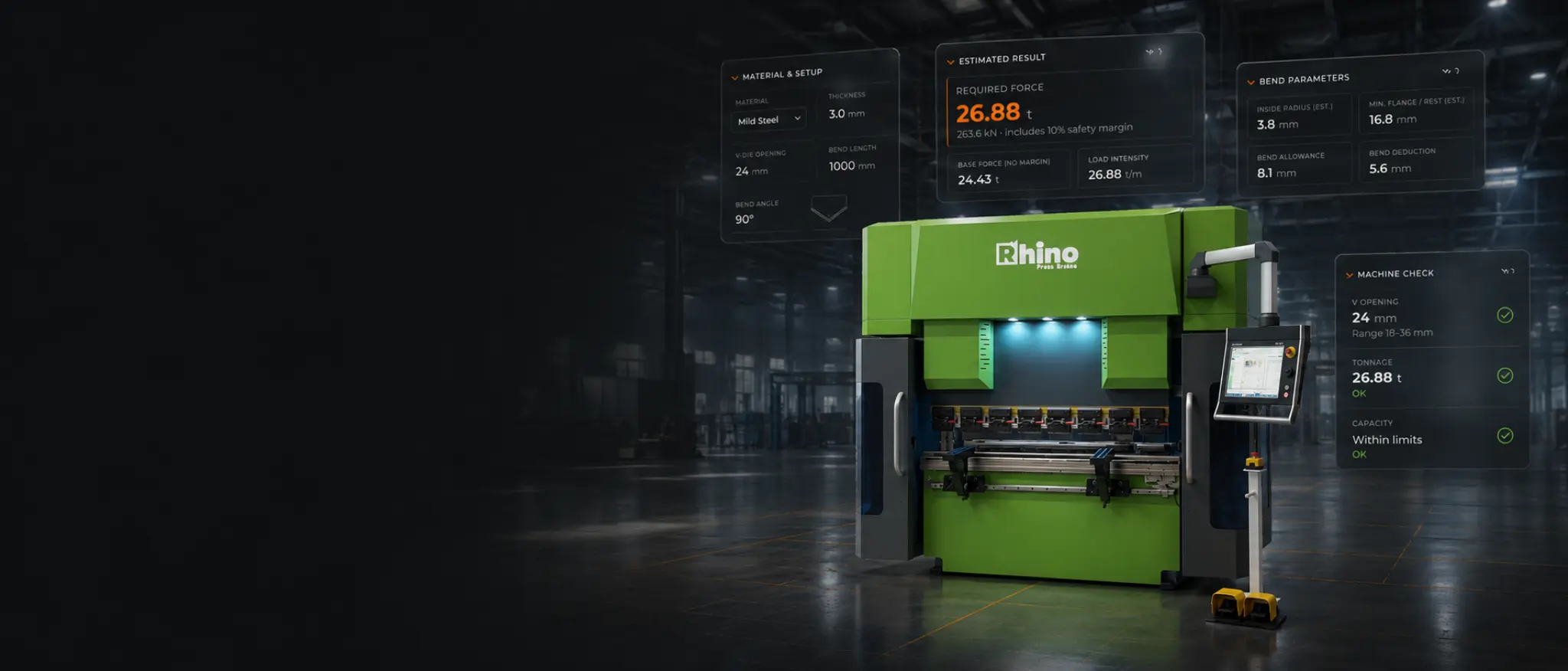
Free planning tool
Plan press brake jobs with clearer force and tooling expectations. This calculator helps UK fabricators estimate bending tonnage, die opening and geometry before programming or quoting — especially useful when comparing machine capacity or tooling limits.
Live calculator
Enter material, thickness, bend length and angle to estimate air-bending tonnage, recommended V-die opening, inside radius, minimum flange length and optional flat-pattern values.
V-die opening (mm): Use auto 8×T for a typical air-bending starting point, or override when you know your die width.
How it helps
Plan press brake jobs with clearer force and tooling expectations. This calculator helps UK fabricators estimate bending tonnage, die opening and geometry before programming or quoting — especially useful when comparing machine capacity or tooling limits.
Using the tool
Select material and thickness.
Enter bend length and angle.
Review recommended V opening or enter your planned die width.
Check estimated tonnage, inside radius and minimum flange.
Optional: open advanced options for safety margin and flat-pattern outputs.
Sample calculation
Inputs
Results
Planning accuracy
Narrower V increases tonnage quickly; wider V reduces force but increases radius and minimum flange.
Compare required tonnage with rated machine force and bed length before committing to a job.
Check tonnes per metre against punch and die manufacturer ratings.
Bend allowance and deduction are estimates — verify with a test piece when dimensions are critical.
Common questions
Tooling limits: Check tonnes per metre against punch and die manufacturer ratings — not just total machine tonnage.
Flat patterns: Bend allowance and deduction are estimates — verify with a test piece when dimensions are critical.
No. It provides transparent formula-based estimates. Your tooling supplier chart and test bends remain the final reference.
Rated tonnage and bed length should match your longest and heaviest routine bends.
Backgauge reach, tooling inventory and CNC control features matter as much as raw tonnage.
Document material, thickness, V opening and estimated tonnage on internal quotes.
Add a safety margin when comparing against machine capacity — especially on stainless or thick plate.
Force looks too high? Try a wider V opening within the 6T–12T range.
Minimum flange warning? Short flanges may not sit safely on the die shoulders.
Flat pattern mismatch? Run a test bend and measure — K-factor and radius vary by batch.
Planning workflow
Plan press brake jobs with clearer force and tooling expectations. This calculator helps UK fabricators estimate bending tonnage, die opening and geometry before programming or quoting — especially useful when comparing machine capacity or tooling limits.
Designed for workshop planners, estimators and buyers evaluating CNC press brakes. Use it as a quick sanity check — not as a substitute for manufacturer tooling charts, test bends or machine-rated limits.
Press brake planning
A specialist will review your bending requirements and advise on the most suitable press brake for your application. No obligation, no hard sell.