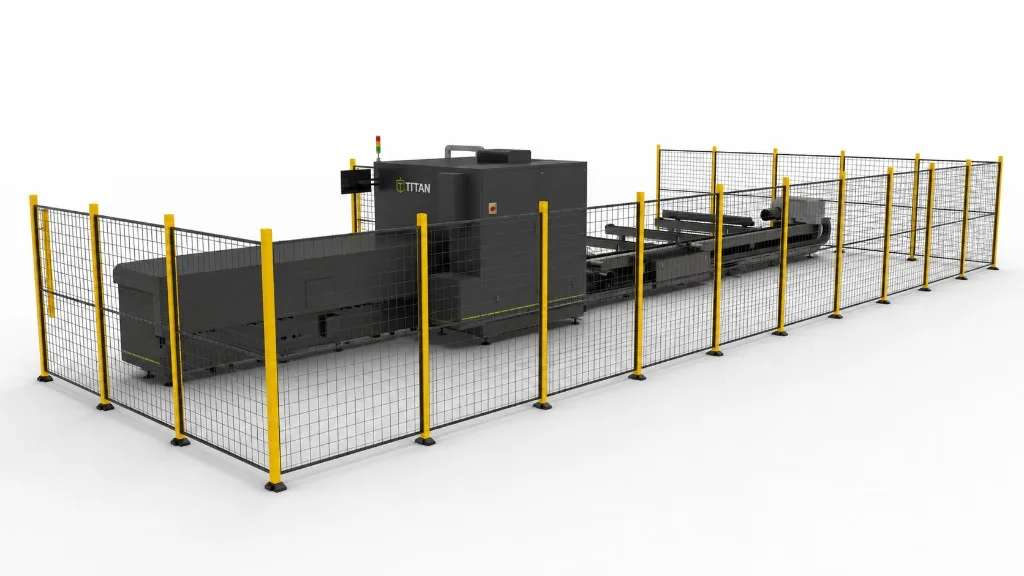
Tube fibre laser cutting brings pipe and profile preparation into one programmed process. A dedicated tube laser can cut lengths, mitres, slots and hole patterns from a digital programme instead of using separate sawing, drilling and coping stations. For UK workshops, the buying decision starts with the profiles handled every week — not a headline speed or maximum-thickness claim.
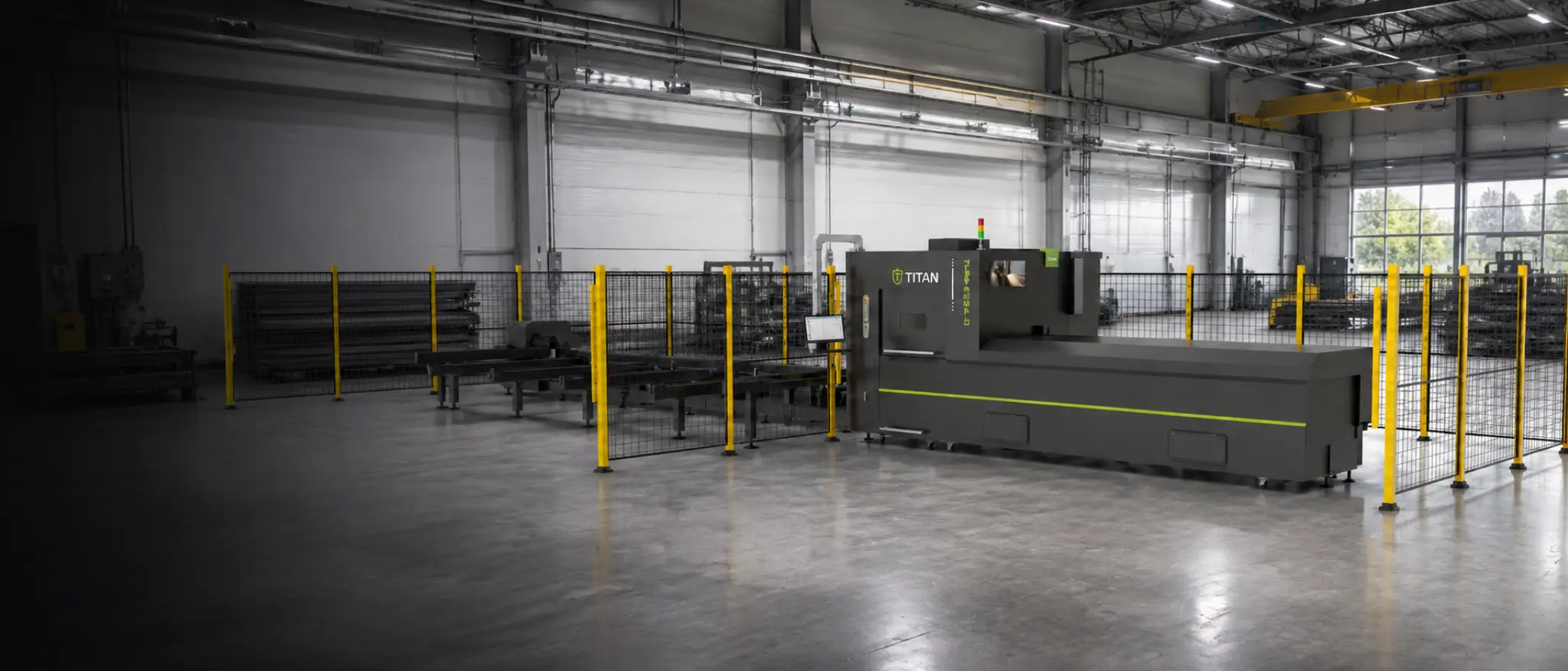
Tube laser selection starts with profile shape, section size, wall thickness and stock flow — automation is only useful when it fits that mix. Review the dedicated Titan T6524 tube fibre laser, place it within the wider fibre laser range, and model utilisation on the fibre ROI calculator before choosing loading method and power.
Ready to scope dedicated tube cutting? Place the Titan T6524 within the fibre laser cutters range, model utilisation with the fibre laser ROI calculator, and review UK installations before the site survey.
The short answer: match the machine to your tube mix
- List round pipe, square tube, RHS, SHS and structural profiles separately; each shape places different demands on clamping and support.
- Record diameter or section size, wall thickness, stock length and batch quantity for your most frequent jobs.
- Choose the loading method around that real profile envelope — automation does not automatically provide the largest capacity.
- Judge 3 kW or 6 kW against everyday material and duty, then prove the shortlist with your own drawings and sample stock.
See the live Titan T6524 tube fibre laser, or start with the wider fibre laser cutters hub for Mantech’s current UK range.
What a tube fibre laser cuts
A tube laser is built around controlled rotation and support of long stock. On the Titan T6524, a 2-chuck vertical system with a movable front chuck holds and turns the material while the cutting head follows the programmed geometry. That makes the platform relevant to round pipe, square tube, RHS, SHS and supported structural profiles rather than flat sheet.
Typical work includes handrails, structural frames, furniture, engineering tube, architectural metalwork and subcontract cut packages. The published T6524 material set covers mild steel, stainless steel and aluminium tube. Capability still depends on section size, wall thickness, material, chuck pressure and power, so a sample cut is more useful than a generic maximum.
Loading method changes the usable profile range
Manual, semi-automatic and fully automatic loading are separate T6524 order configurations. The manual option provides the largest published clamping envelope; the automated options trade some range for a different handling workflow.
| Loading method | Round tube | Square tube | Published handling note |
|---|---|---|---|
| Manual | φ10–φ230 mm | □10–□230 mm | Largest profile envelope; 240 kg chuck load |
| Semi-automatic | φ20–φ200 mm | □20–□200 mm | 100 kg chuck load; 4000–6000 mm stock |
| Fully automatic | φ20–φ160 mm | □20–□150 mm | Automated intake; quoted as the selected order variant |
All three configurations support 4000–6000 mm material length. For channel, angle, I-beam or H-beam, provide the exact section standard and weight during application review because structural limits differ from round and square dimensions.
Choosing 3 kW or 6 kW for tube work
The T6524 offers a 3 kW or 6 kW MAX fibre source. Three kilowatts is the production entry point for lighter-gauge tube; 6 kW adds headroom for a broader mixed workload and heavier daily duty. Choose by wall thickness, material, geometry, assist gas and throughput — not power alone.
- Use your highest-volume material and wall thickness as the baseline, not an occasional outlier.
- Separate mild steel, stainless and aluminium because assist-gas and edge expectations differ.
- Include pierces, slots, mitres and small holes in test programmes; straight cut speed alone does not represent the complete job.
- Compare finished-part time, including reduced drilling, coping and weld preparation, rather than laser cycle time alone.
The fibre laser power guide explains the wider kW decision for sheet platforms. For tube, keep the decision within the T6524’s verified 3 kW and 6 kW tiers and confirm output on your own profiles.
FSCUT control and TubesT nesting
Tube programming differs from flat-sheet nesting. The T6524 uses FSCUT3000DE-M control with TubesT small-tube edition included for 3D tube programming and nest preparation.
TubesT requires internet access for activation and monthly validation. Plan that with workshop IT before commissioning. The professional edition is optional, so confirm whether the included small-tube edition covers the geometry your programmers need.
Where a dedicated tube laser earns its place
The strongest case is not simply replacing a saw. Accurate mitres can reduce fit-up time; programmed holes and slots reduce drilling; repeatable coping can lower weld preparation; and saved programmes simplify repeat batches. Those gains matter most when tube and profile work is a core weekly process.
See real tube processing in the Titan tube laser titanium demonstration and a UK production example in the Bradford tube fibre laser installation. The installation is legacy machinery proof, not a T6524 specification source.
Site planning, extraction and operator training
A tube cell needs a planned material path. Published T6524 dimensions are approximately 9450 × 1945 × 2390 mm before loading and unloading equipment; machine weight is approximately 4200 kg without it. Stock staging, loader access and finished-part collection extend the practical footprint.
- Confirm floor loading, access route and the full selected loading/unloading footprint during the site survey.
- Verify three-phase electrical provision, compressed air, assist-gas supply and extraction routing before delivery.
- Plan network access for TubesT activation and validation without exposing production systems unnecessarily.
- Train operators on loading, chuck pressure, programme setup, daily checks and safe recovery from interrupted cycles.
Review fibre-cell fume control on the Kemper extraction hub and general ownership planning in the fibre laser maintenance guide.
Tube fibre laser buying checklist
- Export twelve months of tube jobs by shape, size, wall, material, length and quantity.
- Identify the profile sizes that must run automatically and those that can remain manually loaded.
- Provide representative 3D files or drawings, including difficult joints and small features, for sample cutting.
- Measure total current labour across sawing, drilling, coping, dressing, fit-up and rework.
- Confirm software edition, network access, extraction, gas, electrical supply and stock-handling space.
- Agree installation, commissioning, training, warranty and service response before signing off the specification.
Explore the Titan T6524 tube fibre laser
Mantech supplies the Titan T6524 with UK delivery, installation, commissioning and operator training. The 2-chuck platform is configured around your chosen loading method and either 3 kW or 6 kW output, with the final specification confirmed against your tube and structural-profile workload.
Review the Titan T6524 product page, model the wider ownership case with the fibre laser ROI calculator, or call 0121 541 1444 to arrange an application review.
Useful next reads
- Fibre laser cutting guide
Understand the process, materials and platform families before comparing machines.
- Titan T6524 tube fibre laser
Full loading, power, software and support specification for the live tube platform.
- Fibre laser ROI calculator
Model shift pattern, throughput and ownership assumptions without public list pricing.
- Fibre laser cost guide (UK)
Plan the wider ownership costs around installation, gas, extraction and support.
- Fibre laser maintenance checks
Build routine care and operator checks into the ownership plan.
- UK machinery installations
See Mantech machinery commissioned in production environments.
Frequently asked questions
What profiles can a tube fibre laser cut?
A correctly specified tube fibre laser can process round pipe, square tube, RHS, SHS and supported structural profiles. The exact capacity depends on the chuck and loading configuration, material, wall thickness and section standard. Confirm your real profile schedule rather than relying on one maximum diameter.
What size tube can the Titan T6524 handle?
Published limits vary by loading method. Manual loading reaches 10–230 mm round and 10–230 mm square; semi-automatic reaches 20–200 mm for both; fully automatic reaches 20–160 mm round and 20–150 mm square. Material length is 4000–6000 mm. Final limits must match the ordered configuration.
Should I choose 3 kW or 6 kW for tube cutting?
Choose against your everyday material, wall thickness, geometry and required throughput. Three kilowatts suits lighter-gauge production entry work; 6 kW adds headroom for a broader mixed workload and heavier daily duty. Sample-cut representative profiles before finalising the source.
Is automatic loading always the best option?
No. Automation can improve handling for repeat production, but the T6524 manual configuration has the largest published profile envelope. Select manual, semi-automatic or fully automatic loading around profile range, batch size, labour and stock flow; one method is quoted per machine.
What software does the Titan T6524 use?
The T6524 uses FSCUT3000DE-M control with TubesT small-tube edition nesting included. TubesT requires internet access for activation and monthly validation, and its professional edition is optional. Confirm the required edition and network arrangements before commissioning.