The right CNC router can improve production, reduce outsourcing, increase repeatability and open new work — but only when it matches your material mix, sheet sizes, tooling needs and growth plans. Headline bed size or lowest ticket price alone rarely delivers the best outcome. These five considerations help UK workshops, schools, colleges and manufacturers shortlist the correct Mantech platform before you request a demo or quote.
Bed format, spindle power and control software matter more than brochure headline speed. Our buyer's guide compares Spartan, Falcon and Apollo on real UK jobs, the ROI calculator models payback from your shift pattern, and the CNC hub walks each range in detail.
The short answer: choose around the job, not just the machine
Start with what you cut, how often, how accurately and how many tools each programme needs. A compact manual-change router may suit first investment and education; automatic tool change pays back when multi-tool nests run every shift. Bed format must fit your standard sheet or panel size — nesting a full 8×4 blank on a smaller table means joins, rework and lost margin.
For side-by-side range comparison, read our CNC routers buyer's guide — this article walks the decision factors; the buyer's guide ranks Spartan, Falcon and Apollo for UK roles.
1. What materials will you cut?
Material choice drives spindle power, tooling, bed setup, extraction and machine specification. Match the platform to your everyday stock — not a one-off sample.
- MDF and plywood — common on entry and mid-size routers for cabinetry, joinery and general workshop routing.
- Hardwood and sheet timber — spindle power and vacuum hold-down matter for clean edges and stable nesting.
- Plastics and composites — suitable on many CNC routes with correct tooling and extraction.
- Aluminium sheet and light non-ferrous work — achievable on appropriate spindle and feed settings; verify capability with sample parts before you buy.
- Signage board and ACM-style panels — typical Falcon and production ATC workflows.
- Cabinet and joinery sheet goods — often multi-tool nests where automatic tool change reduces downtime.
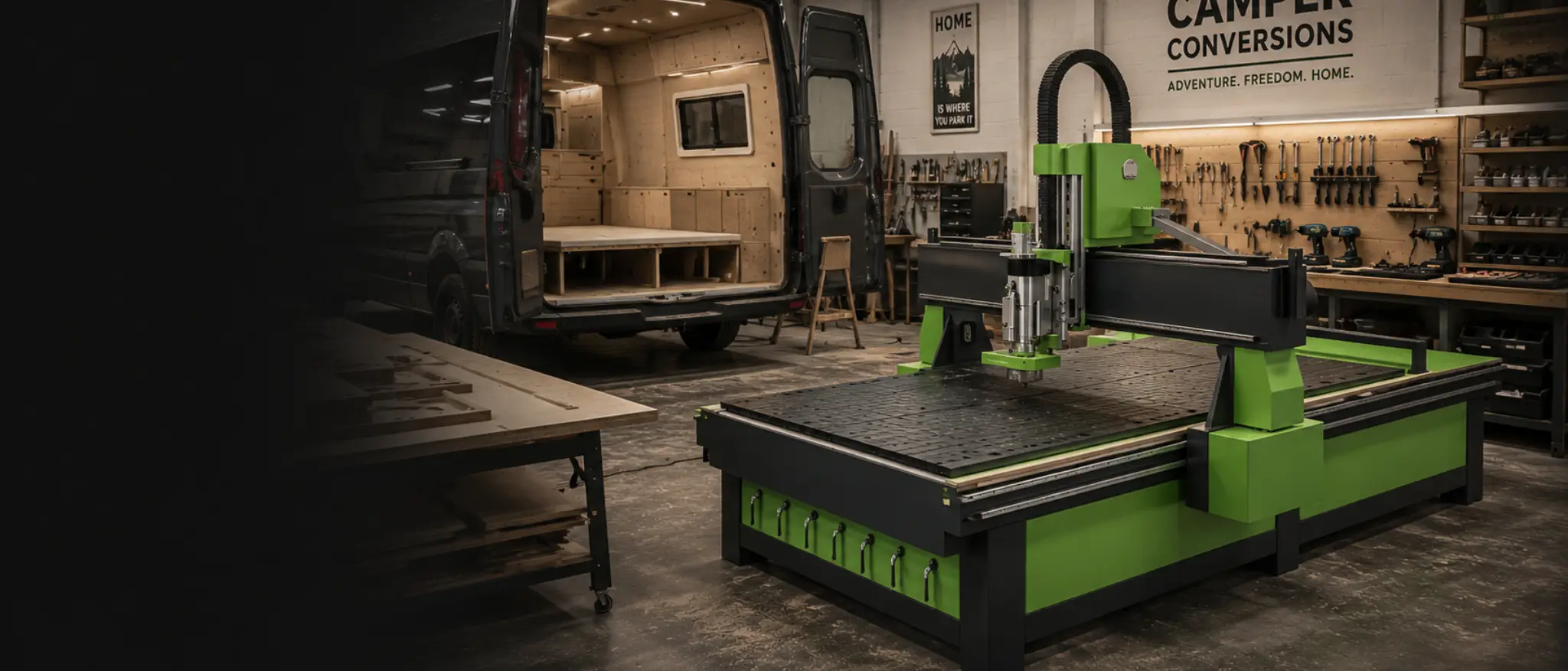
- Campervan conversion panels — nested sheet work; see application examples on installations.
Browse sector use cases on the applications hub, CNC routers for sign making and campervan conversion benefits where those jobs match your quoting.
2. What sheet size and bed format do you need?
UK workshops commonly work around compact 600 × 900 mm tables for smaller footprints, 1300 × 2500 mm (8×4-style sheet) for general industrial routing, and 2000 × 3000 mm or larger for full-size panels and high-volume production. Choose a bed that fits your largest everyday nest without excessive repositioning.
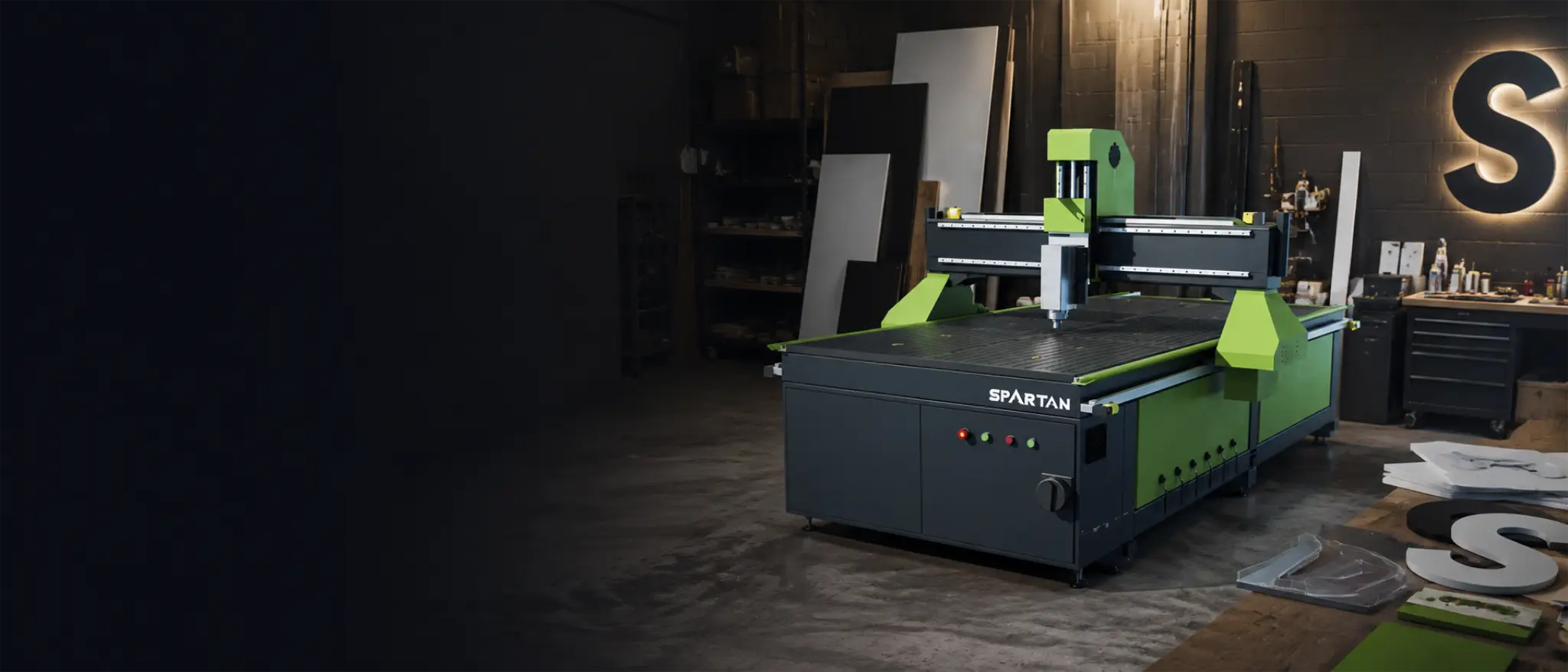
Spartan covers entry-level 8×4 and 10×5 formats on the Spartan CNC router page. Falcon ATC is available in multiple table sizes including 1325, 1530 and 2040 on the Falcon ATC product page. Compare every live range on the CNC routers hub.
3. Manual tool change or automatic tool change?
Manual tool-change machines suit simpler jobs, startups, education and lighter daily use — the operator swaps tools between operations. Automatic tool change (ATC) stores multiple tools on the machine and changes them within the programme, which suits cabinetry, signage, plastics and repeat multi-tool production.
- Spartan — manual tool change; entry-level 8×4 and 10×5 routing for workshops entering CNC.
- Falcon ATC — 10-tool automatic tool changer with linear tool rack (not a carousel); 9.0 kW production spindle on the Falcon ATC platform.
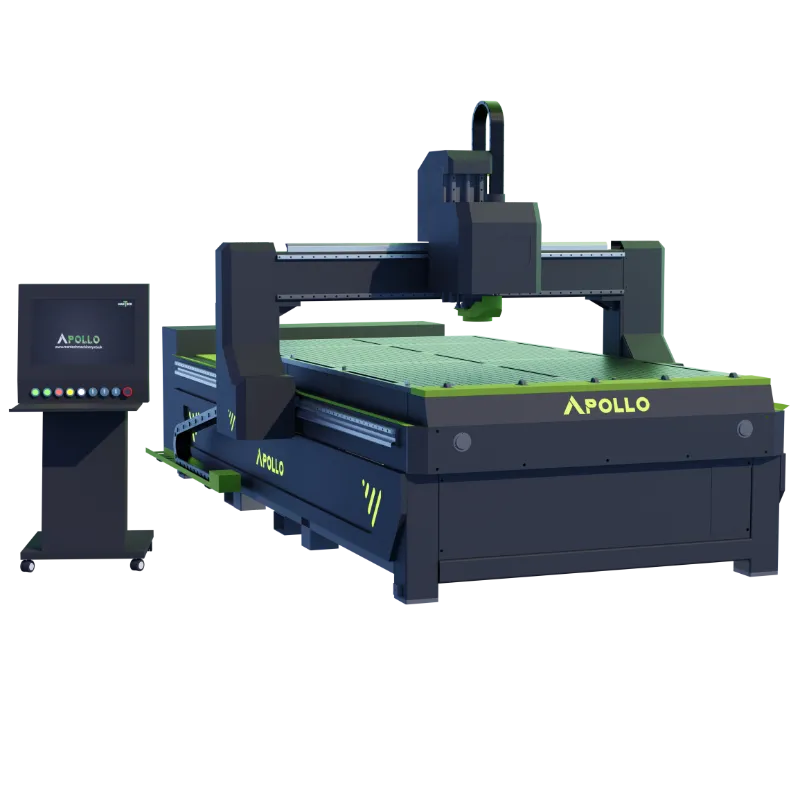
- Apollo M — manual-change platform with a defined upgrade path to 10-tool ATC when throughput grows.
- Apollo ATC range — 10-position automatic tool changer on heavier-duty production beds; see the ATC hub for current models.
Explore Apollo ATC CNC routers for professional production ATC and Falcon ATC for mid-to-high production with linear rack tool change.
4. What level of production and automation do you need?
Occasional routing tolerates manual tool changes and simpler workflow. Regular production needs repeatability, sensible tool libraries, reliable vacuum hold-down and a control system your team can run confidently day after day. Pop-up pins, matrix vacuum zones and nesting software become important as volume grows — not optional extras you add after a bottleneck appears.
Plan for operator training, extraction and a realistic upgrade path. Apollo M buyers can step up to ATC without replacing the whole platform when shift length justifies it. Falcon and Apollo ATC routes assume multi-tool, higher-throughput work from the outset.
Model payback on the CNC router ROI calculator and read the CNC router ROI article or business case guide before you fix budget.
5. What support, installation and training will you need?
A CNC router is only as useful as the handover. Mantech supplies UK installation, operator training, applications advice and nationwide engineer support from Halesowen — matching machine, extraction and software to your material and workflow, not a generic box drop.
- UK mainland delivery and on-site commissioning on supplied platforms.
- Operator training on control and CAM workflow at handover.
- Telephone and field support for production issues.
- Applications guidance — sample parts, nesting strategy and tooling direction before you commit.
- Education buyers — warranty and funding context on the education machinery hub.
Review monthly CNC maintenance checks and vacuum bed best practices alongside machine spec. Colleges should also read the education machinery hub.
Spartan, Falcon or Apollo: which route should you explore?
- Spartan — first CNC investment, manual tool change, entry 8×4 and 10×5 formats; ideal for startups and workshops proving in-house routing.
- Falcon ATC — production automatic tool change with 10-tool linear rack, multiple bed sizes including 1325 and larger; cabinetry, signage and nested sheet work.
- Apollo M — manual-change 1325 platform with upgrade path to 10-tool ATC when production grows.
- Apollo ATC — heavier-duty 10-position automatic tool changer for continuous multi-tool production; explore the ATC range hub.
Start on the CNC routers hub, then open the Spartan, Falcon ATC, Apollo M or Apollo ATC pages that match your shortlist. New to CNC? Read CNC routers for beginners first.
Common buying mistakes to avoid
- Choosing purely on lowest headline price — ownership cost includes tooling, extraction, software time and support.
- Underestimating bed size — spliced panels cost margin and finish time.
- Ignoring workholding and tooling — vacuum strategy and cutter library matter from day one.
- Skipping extraction planning — dust control is part of responsible install, not an afterthought.
- Buying without training and UK support — downtime on the first month erases savings.
- Staying manual when programmes need six or more tools every nest — ATC pays back in cycle time.
- Buying too small for quoted growth — match bed and automation to where quoting is heading in 24 months.
Build your cutter library with our CNC router tooling guide — compression, upcut, downcut and application packs matched to professional routing work.
Why buy through Mantech?
Mantech matches Spartan, Falcon and Apollo platforms to real UK jobs — installation, training, service backup and range guidance from staff who understand fabrication and education environments. Demo with your material when you are ready; call our UK team with nest files and floor dimensions.
Call 0121 541 1444 or request a quote from the relevant product page. See live installs on installations.
Useful next reads
- CNC routers buyer's guide
Structured comparison of Spartan, Falcon and Apollo for UK fabrication roles — deeper than this selection checklist.
- Spartan CNC for startups
Focused read when first CNC investment and floor space are the main constraints.
- CNC router ROI calculator
Model payback from your shift pattern before you fix bed size and ATC tier.
- CNC router tooling guide
Choose cutters and tooling packs for your material mix before you fix feeds and speeds.
- What is a CNC router?
Process basics if your team is new to CNC routing terminology and workflow.
- Falcon ATC CNC router
Full product specification when multi-tool production is your primary goal.
- 5 reasons to buy a CNC router
A concise commercial case when you are still justifying in-house routing.
Frequently asked questions
What size CNC router do I need?
Match bed format to your largest everyday nest. Compact 600 × 900 mm suits smaller workshops; 1300 × 2500 mm covers typical UK 8×4-style sheet; 2000 × 3000 mm and larger serve full panels and high volume. If you regularly nest full sheets, do not undersize the bed.
Should I choose a manual tool change or ATC CNC router?
Manual change suits simpler jobs, education and lighter use. ATC suits multi-tool production — cabinetry, signage and nested sheet where programme tool changes every cycle. Falcon ATC uses a 10-tool linear rack; Apollo offers manual M platforms with an ATC upgrade path.
What is the best CNC router for a small UK business?
Depends on material, sheet size and daily volume. Many SMEs start on Spartan for entry 8×4 or 10×5 manual routing; growing fab shops often step up to Falcon ATC for automatic tool change. Compare roles in the buyer's guide and model ROI before you decide.
Can a CNC router cut aluminium?
Light aluminium sheet and non-ferrous work are achievable on appropriate spindle, tooling and feed settings — verify with sample parts on the machine you plan to buy. Heavy ferrous machining is outside typical CNC router scope; match expectations to platform capability.
What should I check before buying a CNC router?
Material and sheet size, manual vs ATC tooling needs, production volume, vacuum and extraction, control software, installation space, training and UK support. Shortlist on the CNC hub, read the buyer's guide, then demo with your own nest files.